
https://www.linkedin.com/pulse/summer-camp-anti-social-geeky-gamers-all-nolte-big-fat-writer
Written by niece, Tammie. Adam is her son. John Leijendekkers is her husband. Proud of them! They live in The Netherlands.
https://www.linkedin.com/pulse/summer-camp-anti-social-geeky-gamers-all-nolte-big-fat-writer
Written by niece, Tammie. Adam is her son. John Leijendekkers is her husband. Proud of them! They live in The Netherlands.

http://practicaltheory.org/blog/2016/07/07/for-white-teachers-in-the-time-of-bla
I copied from Chris Lehmann and he from — #edchat#educolor
For White Teachers in the Time of #BlackLivesMatter
This is a post for white teachers – it doesn’t matter if you teach at predominantly white schools or schools with a majority of students of color. I don’t pretend to have big “A” Answers, but what I hope this post does is help you make sense of the role you play as our nation grapples with one of the most challenging issues of our time – police violence and how that is magnified against African-Americans.
In the past two days, we’ve seen two videos of Black men dying after having been shot by police officers. The videos are almost impossibly hard to watch. We’ve seen the partners and children of these men react to their death – and those videos are nearly as hard to watch as the deaths themselves. These killings are the most recent example of how many people die at the hands of police officers in America — and importantly — how there is deep racial inequity about who dies at the hands of the police. In 2015, 7.27 African-Americans per million were killed by police while 2.93 white Americans per million were killed by police. (http://theguardian.com/thecounted) American police officers kill more people per capita than most other places in the world. And American police kill African-Americans more than they kill anyone else.
And while this racial inequity in US policing is not new at all, the probability that our students have experienced watching the video of seeing people die — possibly not by choice if they have auto-play turned on on Facebook — is a modern phenomenon.
These issues come into our classrooms, whether we acknowledge them or not. And as Pia Martin (among others) reminds us, there is no such thing as passive anti-racism. We, as white teachers, do not have the luxury of pretending the world doesn’t impact our classroom and our students. Whether we choose to directly deal with the issue in our classrooms or not, we have a moral obligation to be caring and thoughtful in our classrooms – especially to those who may be experiencing trauma due to these events. With that, some thoughts on how to be a caring white teacher in these times:
This isn’t a comprehensive list. This can’t be a step-by-step guide. There is no way to just lesson plan our way through this. But we have to be part of the solution. We cannot assume that others will deal with this, or think that this isn’t an issue that affects our schools. And we cannot leave this issue for African-Americans to try to survive their way through. White teachers, it is time for us to carry our weight and do our part to make sure that all our students understand how important this issue is — and that our Black students feel from us that one societal institution – our schools – are for them, even as the images they’ve seen in these past few days have made many feel that another societal institution – the police – is not.
cklivesmatter/
Monday, June 27, 2016 – We Back Pat
In 2011 some family members happened to be in Knoxville, Tennessee when it was announced that legendary and Hall of Fame basketball coach, Pat Summitt, had been diagnosed with the early onset on Alzheimer’s. Immediately the University of Tennessee began to show their support with these shirts. Knowing the basketball and sports fan that I am my family bought me one.
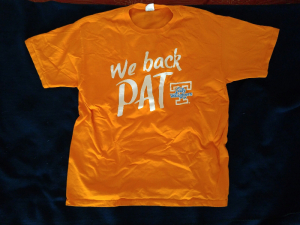
Today our thoughts and prayers go to the immediate, extended and basketball families of Coach Summitt and to all families, friends and caregivers who have loved ones who suffer this horrible disease. May the medical community soon find a cause, treatment and cure for Alzheimer’s. Meanwhile, We Back Pat! And all the others.
This blog contains a copy of each of the Paula’s Pearls on Research emails sent out to faculty and students designed to help members of the Walden Riley College of Education and Leadership TL…
Source: About
Delia, only you, my friend!
Love ya,
Kay
March 24, 2016 – Holy Week and I Think Jesus Would Have Played Sports
I think Jesus probably would have played sports. Of course the only sport of the day was having the Christians eaten by lions and other forms of torture and He was not into that until the end. Thank God. He did seem to enjoy fishing.
I think He would have played soccer, baseball and golf and all other sports. Why those three? Not only are those thinking sports, they are sports known for their diplomacy and etiquette and breaking social and political norms and rules across all geopolitical barriers.
He was good at basketball too – of course He could play all five positions, but is best at point guard. He already had a team – The Disciples.
Of course He would have played football. In Texas football is a religion. I think He would be…
View original post 120 more words

Source: Carol Burris to CEO of ExxonMobil: “Leave Our Children Alone”
The WordPress.com stats helper monkeys prepared a 2015 annual report for this blog.

Here’s an excerpt:
A San Francisco cable car holds 60 people. This blog was viewed about 250 times in 2015. If it were a cable car, it would take about 4 trips to carry that many people.
Click here to see the complete report.

Reblogged on WordPress.com
Source: Using a “Design Display” to Guide Qualitative Research Design
An important lesson in research design is the idea of learning from past research in order to not repeat the “mistakes” from comparable research in a given area. In qualitative research, if recruiting participants via email has reaped mediocre levels of response and cooperation in the past, a different recruiting strategy (e.g., personal letters by way of FedEx followed by phone) would be adopted for future studies with this population segment. And, if a particular moderating technique has not resulted in a dynamic and open focus group discussion on a certain topic, the researcher will dig deeper next time into the proverbial “toolbox” to find a more effective approach.
To facilitate the design process, while keeping in mind what has “worked” and “not worked” in the past, it is useful to create some type of grid or display of earlier research. This grid might include the researcher’s own work in…
View original post 221 more words


 kayabernathy